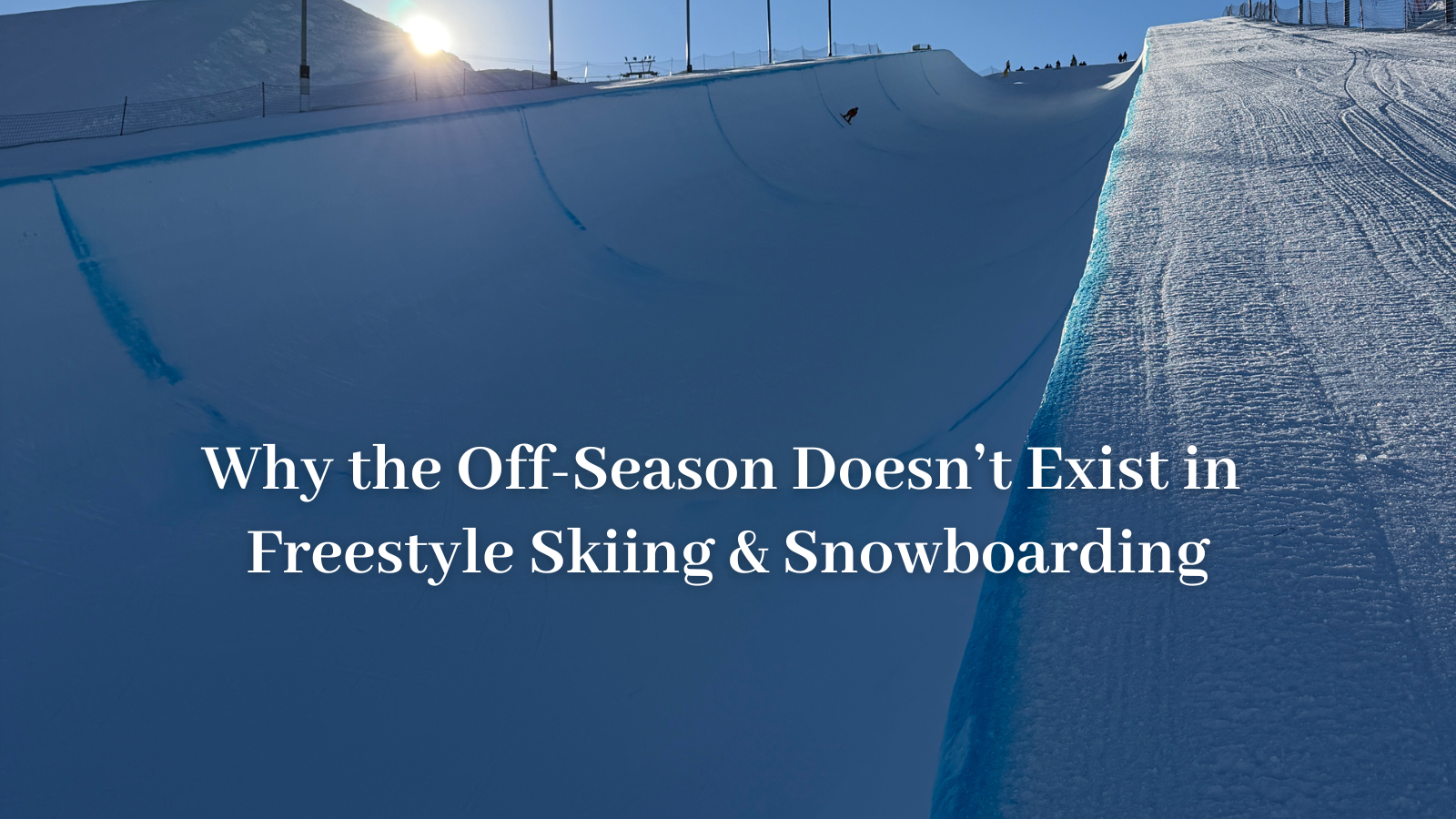
Why the Off-Season Doesn’t Exist in Freestyle Skiing & Snowboarding
When I first saw a full annual calendar for a freestyle skiing and snowboarding team in 2018, I was genuinely surprised.
It didn’t resemble the annual training models I had been taught, or expected to apply. The 16-week off season didn’t exist.
There definitely wasn’t time to do a textbook block periodization training plan that progressively built up to a single peaking event.
Instead, the ‘off-season’ was a series of 2-4 weeks at home coupled with 2-6 weeks training at a halfpipe multiple time zones away.

The Off-Season Picture:
Across a 36-week window, these athletes spent roughly 15 weeks on snow, travelled across five countries and three continents, and rarely had more than a few uninterrupted weeks at home. The weeks at home also coincided with an opportunity to take in the ‘festivities’ of the Calgary Stampede.
In this world, the “off-season” isn’t a protected training phase. It’s fragmented time with short windows at home interrupted by travel, camps, and early snow opportunities.
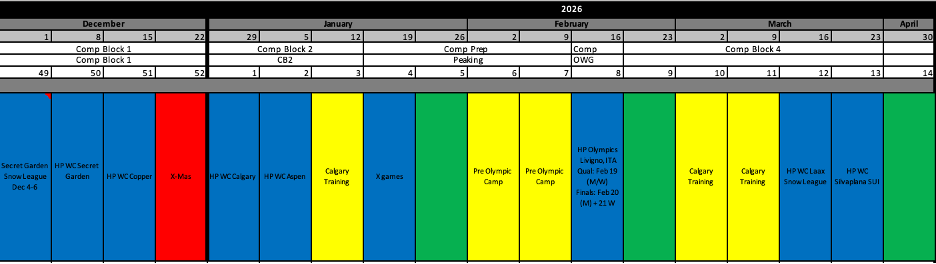
Rolling into The Competition Season:
That fragmented off-season transitions almost immediately into a 17-week competition season, split into two main competition blocks.
In the season leading into the 2026 Olympic Games, one block alone included five competitions over six weeks (with the lone break being Christmas week).
Add an additional transatlantic trip for the Olympic Games, on top of events in China, Canada, and the United States, and the result is a competition season that is dense, travel-heavy, and unforgiving.
The Skill-Based Training Conundrum
A defining feature of acrobatic mountain sports like halfpipe skiing and snowboarding is the constant need to learn and progress new skills. Naturally, this work happens during what would traditionally be considered the off-season.
The development of competition-ready tricks typically follows a clear progression path: early off-season camps focus on initial skill development, mid off-season periods are used to refine and stabilize those skills, and as the competition season approaches, new tricks are integrated into full runs and multi-trick sequences.
This creates a fundamental challenge for physical preparation.
The very window that allows for meaningful skill progression is also the period when athletes are returning directly from an intense competition season. Instead of a prolonged recovery or detraining phase, they are expected to build toward executing tricks they have never performed before, or, in some cases, tricks that have never been successfully attempted in competition.
From a purely physiological standpoint, a period of rest and reduced training load after the season would seem optimal.
In reality, the opposite is often required.
Athletes frequently need to be at their highest levels of physical readiness in the weeks and months immediately following competition, precisely when traditional models would prescribe recovery and rebuilding.
Year-Round Periodization Plan
I utilize a vertical integration periodization approach because of the demanding, year-round schedule.
Vertical integration always keeps all physical training qualities in a program, with different biases and focuses based on seasonal phase, athlete needs and sport KPIs.
This allows for progression in the attributes that are required for on snow performance, and navigates the need for continuous readiness across the season.
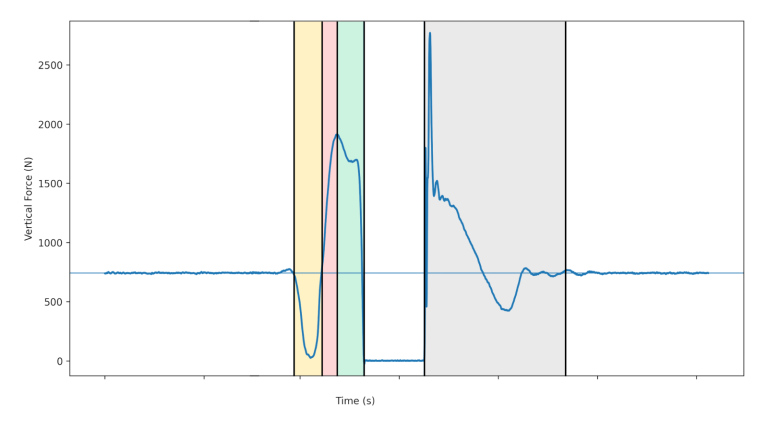
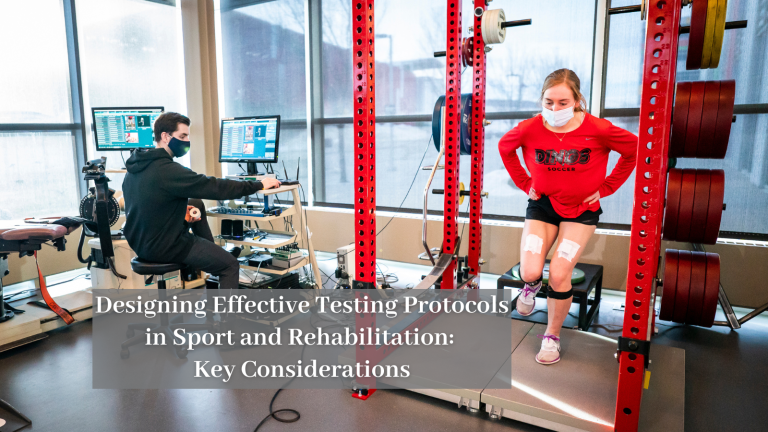
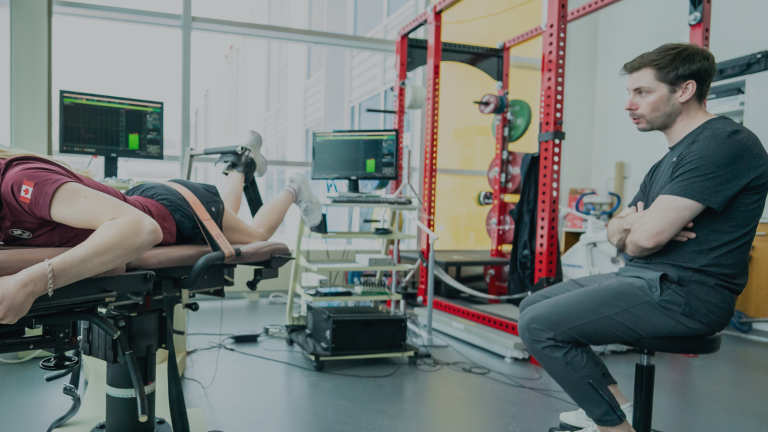
A vertical integration approach relies on frequent feedback on KPI progress. Therefore, continuous monitoring, via force plates and dynamometry, is an integral component to the interplay between off-snow physical preparation and the demanding on-snow schedule.
Testing and monitoring closes the objective feedback loop. This is when we understand if things are working as we desire, and where we need to focus next.
Read More: Designing Effective Testing Protocols in Sports and Rehabilitation